Showing posts with label Bidmeadman's Besties. Show all posts

Friday, 31 July 2015

Bidmeadman's Besties: July


The Duke (Catalyst Game Labs) is a 2-player strategy game with a feudal theme and a timeless, classic feel.

The game is played on a 6x6 square grid, with each player having a set of double-sided wooden Troop tiles. The Troop tiles each display an abstract pattern indicating its move set.


Both players start the game with the same three tiles; one Duke and two Footmen. These are placed on the board, and then on a turn a player can either draw a new tile randomly from their bag and place it adjacent to their Duke, or move one of their tiles already on the board according to that tile's move set.

After a tile is moved it is flipped over. As mentioned before each tile is double-sided, and the two sides have slightly varied move sets. This means a tile's movement changes back and forth between two configurations with each placement.


When a Troop tile moves in to a space occupied by an enemy Troop that Troop is captured and is removed from play. The game is won as soon as a player captures the opponent's Duke.

There is a good variety of movement between the pieces. Some can simply move a few squares in a direction, some can jump over other pieces, some can slide across the board however many squares the player wishes in one direction, some can strike other pieces without moving, some can move other pieces. Often a piece can do a number of these things.


It's an abstract strategy game that feels like it's been around for centuries. An understandably common comparison is Chess. The difference in The Duke is that you can't plan too far in advance as the tiles are drawn randomly, so you have to think on your feet and adjust your strategy according to what you draw and what it adds to your tiles already in play. This is one of the reasons I am so fond of The Duke. I'm not very good at Chess as I'm not good at coming up with long term strategies, but each game of The Duke is different due to each sequence of tiles in each game being different.


The rulebook lists variations of play/alternative objectives you can try once familiar with the basic game. There are capture the flag type games you can play using the Flag tiles included in the game. There are games that pit one particular Troop against several other Troops. There are games that require you to win by earning points through specific objectives.


There are also enhanced tiles that can be included in the basic game rules to add variety and extra strategy. The Dragon for instance is a neutral tile that attacks Troops if they come within range of it. One of its sides is vulnerable however, and although it can't be captured, attacking it makes it more aggressive and lash out. So the right positioning and timing can be used to a player's advantage to create problems for the opponent.


The basic rules on their own bring plenty of replayability, but the inclusion of the other variations of play and bonus tiles means The Duke will be back on the table again and again.

They even include a couple of blank tiles and sheets of customisation stickers so you can create your own Troops.


The Duke is a fantastic game; the tile drawing fills each game with anticipation; the multiple move sets and variety of movement makes each game unique, varied and exciting. Each game is often quite short - usually around 20-30 minutes, depending on a player's analysis paralysis. Although never feeling too short, it always makes you want to try again and see which tiles show up next. This also makes it a good warm-up game or a game to play while waiting for your group to arrive.


The Duke is a modern game with a timeless feel that more than earns its place among the Besties. It's length and accessibility make it an easy choice when looking for a solid two player game, and you'll probably be playing the basic game for ages before you even think about including things like the Dragon or the Mountain. And then there's the alternate objectives/variations of play to explore. And the customizable tiles! There's plenty to explore and experiment with, but at the heart of The Duke there is a solid, fun, satisfying strategy game that feels familiar yet unique.

Do you have an opinion on The Duke? Do you know of any other abstract strategy games I should check out? Let me know here or on Twitter.

Saturday, 27 June 2015

Bidmeadman's Besties: June

This month's Bestie is a short, compact, perfectly formed 2-4 player game called Love Letter (AEG).

No need for fancy extras, like a box.
Princess Annette is heartbroken, following the arrest of her mother, Queen Marianna. As a player you are a suitor looking to court Annette and bring her some joy and affection. However, the Princess has locked herself in the palace, so you must rely on intermediaries to carry your love letter to her before the day is out.

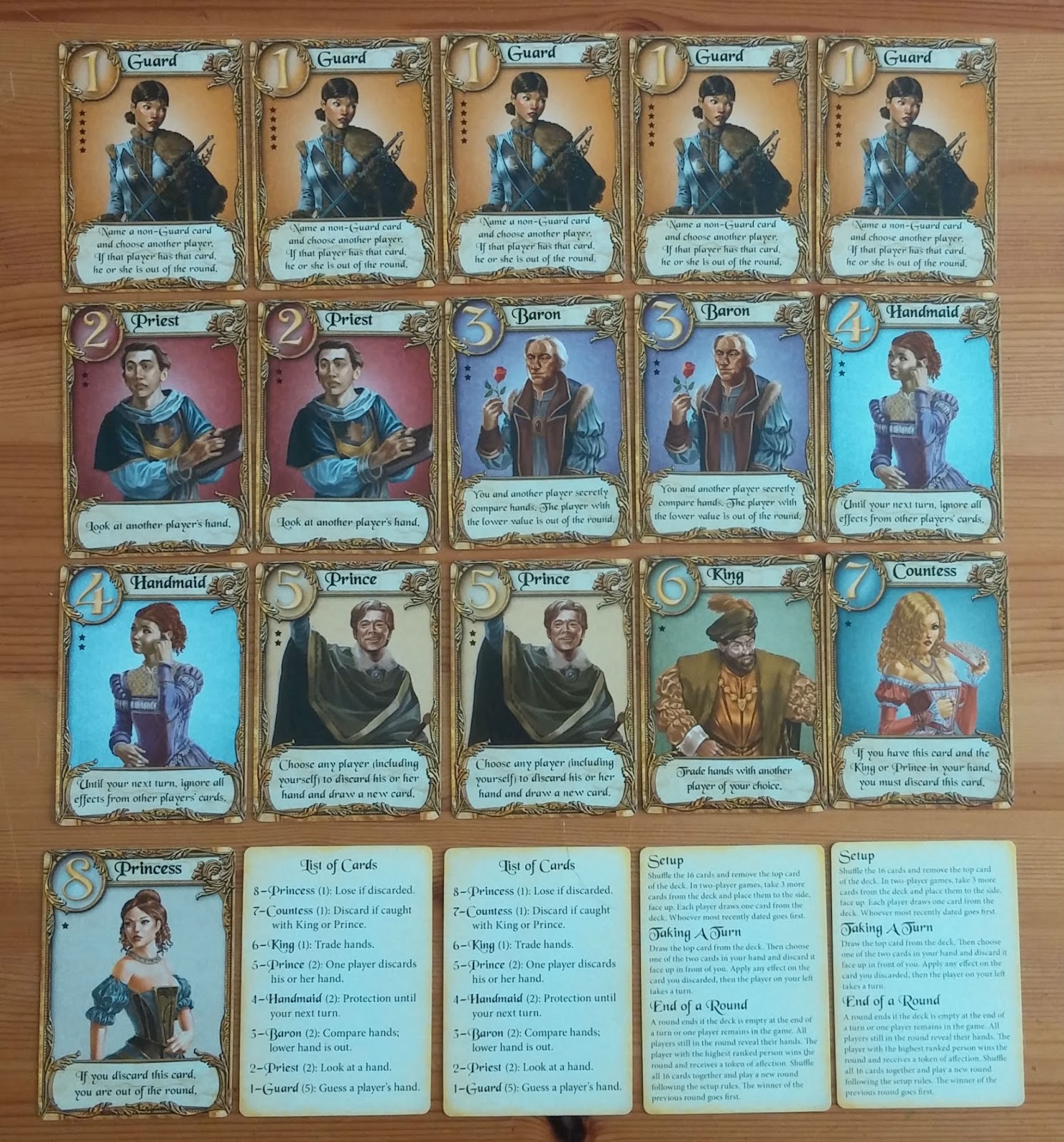
Love Letter consists of 16 cards, each has a character, an ability and a number on it. There are eight characters in total, so some of the cards are duplicates. At the start of a round each player gets dealt a card. On a turn you draw a new card and then discard one of the two cards in front of you, activating the ability of the discarded card. A player wins a round by being the last player to be knocked out, or - if the deck runs out with two or more people still in play - by having hold of the card with the highest value. Rounds continue until someone has won a predetermined number of rounds.


I've never seen so much back story and characterisation in such a small, simple game. Love Letter is among a series of games based within the fictional city-state of Tempest. The rulebook gives a small insight into the world, along with setting up the story behind Love Letter and giving detailed descriptions for each of the characters on the cards. It's an awful lot for what is essentially a 20 minute game of deduction and luck, but the theme feels genuine and purposeful. The artwork is beautiful and thematic too.


Love Letter is an ideal filler game or warm-up game. It's short, relaxing and simple but with just enough deduction, bluffing and luck to keep things interesting. It is, absolutely, one of my favourite fillers to play. It's also ideal for a lazy Sunday afternoon, when you are all sleepy from too much food but still have a hankering for a quick game. My wife and I have discovered that it's possible to play a game during breakfast, while the little one is busy munching on toast.

If you plan to play around food I recommend card sleeves.
The abilities are well matched with the values on the cards. The higher scoring cards are what you want for winning the game, but they are risky. The longer you hold on to a high card the more likely someone's going to play something that sends you out of the round. You have to think on your feet and adapt to each card that gets played, being mindful of what cards have been played, and therefore, which ones are likely to be in your opponent's hand.


The mechanics couldn't be simpler: draw a card, play a card - and you never have in your hand more than two cards. But the card abilities are varied and unique, and all have a great synergistic quality (not always in your favour). The balance of the cards and the simplicity of play means no one has a clear advantage while playing.


If you are looking for a quick, casual card game that is easy to learn and relaxing, with enough strategy, luck and theme to bring you back again and again, Love Letter would be hard to beat. I struggle to think of another game I've played that balances simplicity and enjoyment so well.


Wednesday, 27 May 2015

Bidmeadman's Besties: May

This month it's Power Grid (Rio Grande Games).


In Power Grid the object is to create a network of cities and power them using power plants. Each round you start by buying power plants, then you buy resources to fuel the power plants, then you build your power plants in cities on the game board. Once a player has reached a predetermined number of cities in their grid the game ends, and whoever can power the most cities with the plants and resources in front of them wins. Creating a network of powered cities costs money, but the more cities you can power the more money you can make. So how you balance your spendings and earnings is key to success.

The first step - buying power plants - is done through an auction. You have eight plants on display, each with a base price; the four cheapest are the "actual market", the four most expensive are the "future market". On your turn you have the opportunity to start the bidding on one of the power plants in the actual market. Then each other player is given the opportunity to out-bid the last in the hope to own the plant. Once a plant is purchased another is drawn from a face-down deck and placed within the market, readjusting so the four cheapest are the "actual market". So the future market acts as a way for the players to know what will be available to bid for soon.

Once power plants are purchased the next step is to buy resources to power them. Each plant needs fuel; coal, oil, garbage, uranium (except windfarms/solar plants). The resource market gets more expensive the less resources there are. So coal might cost two elektros (Power Grid's currency) per unit, but as players buy it it'll become three elektros per unit, then four, and so on. So if everybody's using coal-powered power plants it is going to become a pretty pricey way to power your cities. Resources are restocked at the end of each round, each one restocking at different rates. This means a fuel that is more expensive at the start of the game may become a more economical option later on.


The third step is building plants in cities. Each subsequent city you purchase has to connect to one you already own, creating a power grid. A connection fee must be paid when building in a new city, and connection fees vary. You must, therefore pick wisely when connecting cities, otherwise you may spend too much too soon.

Once every player has had a chance to do these three steps everyone can spend the resources they've bought to power their cities and earn money. Money is collected, the resource market is restocked, the auction is adjusted, and a new round starts.

Collecting your money once you're a few rounds in, and have acquired a good amount of cities and the plants to power them, is very satisfying.


There's a lot to keep track of in Power Grid; certain circumstances will cause the auction to be adjusted; fuel is replenished differently depending at what point in the game you are at; player order is changing all the time. A smooth and fair game relies on at least one person knowing the rules really well. It takes a good amount of concentration to hold it all together. However, when you've got a game going with players who know what they're doing Power Grid is a whole lot of fun. I mean, I REALLY enjoy it.

Each of the three steps is a pocket of excitement and tension. The auctioning of power plants is great fun, trying to secure the plant you want while trying to get your opponents to pay too much for theirs; bidding wars have been fun to partake in and to watch. Much satisfaction can be had buying up a resource first for a good price knowing someone else needs it and is going to have to pay through the nose.

You can only buy the fuels that the plants you own need.

Finding the best routes around the board to connect cities takes a lot of forward planning, as to start with each city can only have one player's power plant built within it. A carefully thought out power grid can save you money, but also cost your opponents, as they have to navigate more expensive connections to get past your cities to a vacant space. You have to be constantly aware of your opponents actions.

Player order is determined by the amount of cities each player owns. Whomever has the most cities goes first, the player with the second most goes second, and so on. At auction turns are taken in player order, with first place getting to choose which to bid on first. When purchasing fuel and paying for cities turns are taken in reverse player order. It's a clever way of balancing the advantages players have over each other; powering more cities than anyone else means more money than anyone else, but this also means paying more for fuel and potentially more for connections to cities. You're also less likely to pay the base price for the power plant that you pick.


All the elements of Power Grid come together to make a totally cohesive game. It's solid. It's about planning and taking chances. It's fun.

The one thing I have to say against Power Grid is, although it says 2-6 players, it doesn't really work as a two player game. The auction is made redundant with two players, as there is plenty to go around and never the need to fight over one particular plant. Plus there seems to always be enough space for you both on the board when buying cities, taking away the challenge. I believe there is an expansion available that addresses the issues that arise in two player, but I'd rather not spend additional cash to make the game playable.

Get three or more players together, however, and this game is a blast. Every element is unique and varied, but comes together to form a well balanced, exciting, challenging game.


If you have any thoughts on Power Grid share them with me here or on Twitter.


Wednesday, 29 April 2015

Bidmeadman's Besties: April


Ticket To Ride (Days Of Wonder) is considered by many to be the ultimate "gateway" game, a game to introduce to people who are unfamiliar with the wide world of board games.

In Ticket To Ride you're competing to travel across america securing train routes. The game board is a map of the USA covered in train routes of various colours. As a player you have a collection of trains that you use to connect different cities, earning you points. The more train carriages needed to join two cities the more points you earn.


To place train carriages onto the game board you need to collect the right coloured cards to match the route. So, if you want to connect Denver and Oklahoma City you need to have four red cards in your hand. Once you do you can spend a turn to discard the four red cards and place your trains between the two cities and collect the points.


During a turn you choose one of the following actions: Collect two train cards from the five face-up cards or face-down draw pile, place trains onto the board, collect destination tickets. Destination tickets detail two cities and a number of points. To earn the points on the card you need to have connected the two cities with a continuous line of your trains.


That's Ticket To Ride in a nutshell. Simple, refined mechanics mean it's a breeze to teach/learn/play. Everything's crystal clear; no unfamiliar terminology or symbols, just colours and numbers. It being fun on top of this is the reason it's such a good gateway game, a transitional game between the traditional and the modern. If someone is struggling to see past the familiar family games like monopoly, introduce them to Ticket To Ride.


It can be played and enjoyed by young and old; familiar to board games and unfamiliar. My gamer friends love to play it, my niece and nephew (8 and 12 respectively) love to play it, my non-gaming sister loves it, my cousin bought it to play with his family once he played it and loved it. It's a game for everyone.

It's the lightest of the Besties so far and probably the lightest of all the Besties to come, but that's not to say there's no skill in playing it well; finding the optimum routes and getting to your destinations fastest, knowing when to discard destination tickets and when to keep them. There are strategies to be found and perfected the more you play, and the card drafting system adds anticipation and a small amount of tension.


There's not a lot of opportunity for player interaction. Everyone's got their own goals and it's easy to keep your head in your game, ignoring everyone else. The more players there are the more crowded the map gets and players will block the routes of other players often. However, a two player game can go by without any conflict and it can be a bit like you're each playing you're own game for the most part.

Ticket To Ride is simple and effective. A fun, light, family-friendly, frustration-free, satisfying board game.


Are you a fan of Ticket To Ride? Have you played any of the other maps available? Is this your first time hearing about it? Message or tweet me and let me know your thoughts.


Thursday, 26 March 2015

Bidmeadman's Besties: March

This month is Alien Frontiers (Game Salute/Clever Mojo Games).


Alien Frontiers is a game of "resource management and planetary development" for 2-4 players. You start the game with three dice that represent the spaceships in your fleet. The game board consists of an uncolonised alien planet surrounded by several orbital facilities.


On a turn you roll these "ships" and assign them to the orbital facilities in order to earn resources, expand your fleet, and colonise the planet. As you use the orbital facilities you are working towards landing your colonies on the planet and gaining control of territories. You are in control of a territory when you have more colonies there than any other player. Each territory carries a particular benefit, which you are able to use if you control that territory. This is also how you gain points in Alien Frontiers and ultimately win the game. There are also alien technologies that are used to influence dice rolls among other things.


I remember when I first played Alien Frontiers. It was introduced to me by my friend Alex, who over the years has introduced many games to me (his influence is certainly one of the major factors in igniting my passion for board games). The thing about Alex is that he's good at board games. Better than me. He always beats me. Always! I have come to accept this. When he brought over Alien Frontiers I was prepared to be schooled, and no surprises, he destroyed me. But I loved the game, and felt that with enough forward planning I could beat him. So I rolled my sleeves up and challenged him to another game. And sure enough, with plenty of consideration and strategy I won!


That second game secured my love for Alien Frontiers, not just because I beat Alex, but because it felt like a game with impeccable design. It's a dice game where the level of strategy outweighs the luck of the dice. With a combination of resources, alien tech cards, and the right orbital facilities you can turn almost any dice roll into a successful move towards victory. The dice you place stay in the orbital facilities until the start of your next go when you're ready to roll them again. This means part of a strategy can be to block spaces from other players. There are also field generators that can be placed in territories to tip the balance in your favour. These can stop colonies being placed and prevent territory bonuses being used. The random nature of dice rolling means you have to be prepared to evolve your strategies with each turn,


The scoring system is great: you gain a point by placing a colony on a territory and a point if you are in control of the territory. If another player places a colony in the same territory causing you to lose control, you also lose the point previously gained. This means points increase and decrease throughout the game and it's rare that any one player's score will race ahead. Each game feels very close, with players battling to create a lead of only a few points. I find that sometimes when I'm playing a game that tracks the score as you play it can be a bit disheartening to see another player shoot ahead with no hope of catching up. Alien Frontiers' scoring system doesn't allow that, making every game feel like a close one.


It's so much fun rolling those dice and looking to see how to best use your options to get your next colony down on the planet. Placing dice to get resources, using those resources along with alien tech cards to alter your dice slightly or reuse dice or use an opponents dice (or all three), all to place one more colony and move one point closer to victory is very satisfying. I love dice games, especially when they are used in such a solid way as the main component of a good-sized board game. Alien Frontiers is a game that rewards considered play, manipulating the random dice rolls, and using all the available resources and abilities to your advantage, and with the minimal point system every game is for the taking.


Also, it's got a nice old-school aesthetic, and the territories are named after science fiction writers, which is a nice touch.


Finally, although it's not very glamorous, I am a fan of the storage for Alien Frontiers. They provide boxes for all the components. These split up resources, cards and player pieces, and look a bit neater than a bunch of baggies.


Have you played Alien Frontiers or similar games? Message me here or tweet me and lets talk about games!

Friday, 27 February 2015

Bidmeadman's Besties: February

So many cards!


It's Dominion!

Getting a classic out of the way early in the year, Dominion (Rio Grande Games) is THE deck building game. I haven't met one person who's played this game and not loved it.

Put simply; it's a big box of cards. 500 to be precise. And that's just the base game, there are several expansions as well (but I'll just be sticking to the base game for this post).


It's an easy game to teach:
Everyone starts with the same ten cards - 7 Copper and 3 Estate. The Estate cards are worth victory points at the end of the game and are of no use to start with, but the Copper can be used to buy other cards. Each player shuffles their ten cards to make their own personal draw deck. A turn consists of drawing five cards from the draw deck, using those cards to purchase another card from the centre of the table, discarding the five cards along with the new card, and finally drawing five new cards. Once the draw deck is empty the player then shuffles the discard pile and that becomes the new draw deck, complete with any recently purchased cards. So each time you reshuffle your deck is getting bigger and bigger, filled with more varied and versatile cards.

The cards to purchase consist of Treasure, Victory and Action cards. Victory cards are what you need to win the game; Treasure cards allow you to buy cards during your 'buy' phase; Action cards are used during your 'action' phase and provide the core strategy to a game of Dominion.


There are 25 different decks of Action cards (each deck consists of the same card) and a game is played with a combination of 10 decks. This means there's a whole load of combinations to play with, and loads of variety. The abilities of Action cards allow you to do things like draw more, buy more, steal from other players, make other players discard etc.

It's such a straightforward, simple and pleasing mechanic - shuffle, draw, action, buy, discard, repeat - with plenty of room for strategy. It's really easy to get your head around, which means you can get straight in to buying action cards, playing around with what they do. There's a constant feeling of anticipation, waiting for purchased cards to turn up in your hand to use. There's strategy in trying to figure out the right number of a certain card to have in your deck so the right combination of cards will appear in your hand. Too few and the card won't appear enough; too many and it might clog your deck, stopping other cards from being drawn enough. It's a bit like building a deck for Magic: The Gathering or Pokemon TCG, only with Dominion building the deck is the game.


It's a quick, casual game, and a great gateway game. If you've got a group of gamers - or potential gamers - who just want to get stuck in and not spend loads of time learning rules (what's wrong with them!?) Dominion is perfect. I can teach this game in five minutes, mainly just by taking the first turn and talking through the few steps it entails. And people seem to love it! The folks I game with rarely buy their own copies of games I own, content with playing mine on the occasions that we meet up. But two more copies of Dominion now exist within my gaming circle.

There's no real theme to speak of. There's not a great deal of player interaction.

That's about all I can think to say against it. Even then, those two points don't really amount to much. A stronger theme wouldn't make Dominion more fun for me, it would just be a nice bonus. And although player interaction is minimal depending on the deck combination, it's the sort of game that allows room for interaction outside the game. Great if you want a casual game with room for chatting with drinks and snacks, but still want to plan and play out a strategy. It has a perfect blend of strategy and accessibility.

My wife and I tend to play a lot of games just the two of us, and in my experience I sometimes find games that are designed for 2-? players don't play as well with just two. Dominion is one of the few exceptions I have come across. It's meant for 2-4 players and I think it feels just as great with 2, 3, or 4 players.

So there's my view on Dominion, for what it's worth. I'm interested to know your thoughts and experiences with this game. Do you like it? What expansions have you tried? Is there anything about it you'd change? any favourite cards/strategies? Leave a comment or tweet me.


Friday, 30 January 2015

Bidmeadman's Besties: January

I've decided to pick 12 games in 2015 and write about one at the end of each month. They may be old or new, but the one thing they will have in common is that they will be personal favourites of mine.
January's game is...

Betrayal at House on the Hill (Avalon Hill/Wizards of the Coast). Or Betrayal. Or BAHOTH Or Betrayal at HOTH. You get the idea.


Set within the walls of a dilapidated, spooky mansion the players take on the roles of explorers uncovering the secrets hidden within the many rooms and corridors of the sprawling House on the Hill. The players work together to discover useful items, encounter supernatural events, and develop their characters. At some point one player will inadvertently begin the Haunt: One of 50 different scenarios, which pits one of the explorers - now the Traitor - against the rest in a bid to achieve their fiendish, corrupt goal. Will the heroes manage to foil the evil plans of the Traitor (and the house) in time, or will the Traitor emerge victorious in his/her evil plan?

There are 12 different characters to choose from in the game, represented by 6 miniatures. Its like having 6 characters, each with two personalities.


Each character has a unique set of base stats, which can increase and decrease as they encounter various things within the house.


The game board is made up of room tiles which are drawn randomly by players as they move through the house. This means with each play-through the house will be set out slightly differently.


The only house where the only access to the kitchen
is through the garden.

The thing that is really unique about this game compared to the other games I've played is the Haunt. Each time a player draws an Omen card they must perform a Haunt roll. If the roll is a success the game continues as it was, everyone working together to explore the house. If the roll fails then the Haunt begins, and one of 50 scenarios is chosen, based on the card drawn and the room it was drawn in, and someone is revealed to be the Traitor! This means that until this moment no one knows what the second part of the game is going to be.

Although I would love to go into detail about some of the scenarios I've played, I don't want to risk spoiling anything if you are yet to play this game and think you might like to. But I will say that a lot of horror staples are here; werewolves, zombies, mummies, aliens, psychopaths. It's all here to enjoy, and the Haunts can be quite different from each other.

And of course the worst of them all: Spiders!

I do love to get caught up in a thematic game, and I'm a sucker for spooky (sometimes slightly naff) horror. For me Betrayal invokes the feeling of 80's horror movies. Movies like American Werewolf in London, Return of the Living Dead, Fright Night; those kinds of decent horror films that were fun and had elements of humour. I used to do a lot of horror roleplay (based heavily on Call of Cthulhu), and although playing Betrayal is very different from running a roleplay campaign, its nice to have those elements of horror storytelling and character building in a very accessible board game. There are definitely other games out there that are more immersive with stronger stories, but the replayability due to the multiple Haunts (and always different board layout), the co-op and competitive gameplay, and again, it being such an accessible game (its so easy to teach) makes this one a real winner for me. I've had some great evenings with this game; evenings of tense, thrilling, campy horror. Dig out some snacks, dim the lights, put on some spooky music, and enjoy!

And remember to read your event cards using your best Vincent Price impression.


Oh, and the dice are great! If you've read my previous post you will know that I love me some dice!