Friday, 27 February 2015

Bidmeadman's Besties: February

So many cards!


It's Dominion!

Getting a classic out of the way early in the year, Dominion (Rio Grande Games) is THE deck building game. I haven't met one person who's played this game and not loved it.

Put simply; it's a big box of cards. 500 to be precise. And that's just the base game, there are several expansions as well (but I'll just be sticking to the base game for this post).


It's an easy game to teach:
Everyone starts with the same ten cards - 7 Copper and 3 Estate. The Estate cards are worth victory points at the end of the game and are of no use to start with, but the Copper can be used to buy other cards. Each player shuffles their ten cards to make their own personal draw deck. A turn consists of drawing five cards from the draw deck, using those cards to purchase another card from the centre of the table, discarding the five cards along with the new card, and finally drawing five new cards. Once the draw deck is empty the player then shuffles the discard pile and that becomes the new draw deck, complete with any recently purchased cards. So each time you reshuffle your deck is getting bigger and bigger, filled with more varied and versatile cards.

The cards to purchase consist of Treasure, Victory and Action cards. Victory cards are what you need to win the game; Treasure cards allow you to buy cards during your 'buy' phase; Action cards are used during your 'action' phase and provide the core strategy to a game of Dominion.


There are 25 different decks of Action cards (each deck consists of the same card) and a game is played with a combination of 10 decks. This means there's a whole load of combinations to play with, and loads of variety. The abilities of Action cards allow you to do things like draw more, buy more, steal from other players, make other players discard etc.

It's such a straightforward, simple and pleasing mechanic - shuffle, draw, action, buy, discard, repeat - with plenty of room for strategy. It's really easy to get your head around, which means you can get straight in to buying action cards, playing around with what they do. There's a constant feeling of anticipation, waiting for purchased cards to turn up in your hand to use. There's strategy in trying to figure out the right number of a certain card to have in your deck so the right combination of cards will appear in your hand. Too few and the card won't appear enough; too many and it might clog your deck, stopping other cards from being drawn enough. It's a bit like building a deck for Magic: The Gathering or Pokemon TCG, only with Dominion building the deck is the game.


It's a quick, casual game, and a great gateway game. If you've got a group of gamers - or potential gamers - who just want to get stuck in and not spend loads of time learning rules (what's wrong with them!?) Dominion is perfect. I can teach this game in five minutes, mainly just by taking the first turn and talking through the few steps it entails. And people seem to love it! The folks I game with rarely buy their own copies of games I own, content with playing mine on the occasions that we meet up. But two more copies of Dominion now exist within my gaming circle.

There's no real theme to speak of. There's not a great deal of player interaction.

That's about all I can think to say against it. Even then, those two points don't really amount to much. A stronger theme wouldn't make Dominion more fun for me, it would just be a nice bonus. And although player interaction is minimal depending on the deck combination, it's the sort of game that allows room for interaction outside the game. Great if you want a casual game with room for chatting with drinks and snacks, but still want to plan and play out a strategy. It has a perfect blend of strategy and accessibility.

My wife and I tend to play a lot of games just the two of us, and in my experience I sometimes find games that are designed for 2-? players don't play as well with just two. Dominion is one of the few exceptions I have come across. It's meant for 2-4 players and I think it feels just as great with 2, 3, or 4 players.

So there's my view on Dominion, for what it's worth. I'm interested to know your thoughts and experiences with this game. Do you like it? What expansions have you tried? Is there anything about it you'd change? any favourite cards/strategies? Leave a comment or tweet me.


Thursday, 5 February 2015

Let's Work Together

I think I've fallen in love with Samurai Spirit (Antoine Bauza/Funforge). It's such a satisfyingly tough game.


It's a cooperative game in which you each take on the role of samurai defending a village from raiders. Each turn you can Fight, Support or Pass. If you chose to Fight you draw a raider from the deck and then choose whether to attack or defend. Each raider has a numerical value which goes towards filling your battle track. Go beyond the last number on your battle track and you're out of the round and a barricade burns down, meaning the raiders are closer to taking the village. Defending doesn't fill your battle track, but options for defending are limited so making the right decision at the right time is crucial. Each samurai has a unique ability that they can use and also - by Supporting - have other samurai use. It's quite a simplistic overview of the game (there's much more to it than what I've explained) but there are pros and cons to every choice you can make, and your samurai will have to be in complete harmony if you are going to have any chance of saving the village.


I have limited experience with co-op games. I own several - and I love them - but there are loads out there, with all the variety of competitive games. The people I game with tend to be quite competitive, and so cooperative games don't make it to the table that often. One friend whom I often game with won't touch a co-op. If the goal isn't to thrash the other players she's not interested.

I, on the other hand, don't really mind who wins, I just like to have fun (as soon as I wrote that I felt like a massive loser), but I love puzzle solving. I love the race to the goal - especially when it's close - but I don't get disappointed if I don't win.

I love beating the game though. I love working with the other players to figure out the best way to achieve the objective. For me a co-op has to be hard. I've got to go in to it knowing our chances of beating it are slim. I'm slightly masochistic in that sense. As long as I get a sense that it is beatable I will keep coming back for more. There's so much fun and satisfaction in you and your team beating a really challenging game.

I've only had Samurai Spirit for about a week, so maybe it's too early to really know how I feel about it. But I've played a lot of it in that time and it seems to hit that co-op sweet spot for me. I'm not sure how to explain it. Maybe if I just ramble it'll become clear.


Pandemic (Z-Man Games) is a co-op that has loads going for it. The biggest problem I have with Pandemic is me. I guess it's because I'm usually teaching it (and also because I'm a bit of a control freak), but it can feel like a solo game with 4 people just taking it in turns to move the pieces. It's so easy to play the whole game with one person making all the decisions and just telling the others how to move. Maybe it's because - aside from the individual character abilities - there aren't a lot of individual decisions to be made. Everyone can see at any given moment the next step to take. Sometimes there's a few areas that need equal attention and the players need to figure out where to prioritise, but whenever I'm playing it it's usually the same person making those decisions (hint: it's me!)

It's a hard game, but the more I play it the easier it gets to beat. But then that's why the game has the option to play at a harder difficulty. It's still a fantastic game. I've had some great games where it's been a mad panic to get things under control as the diseases spread at an uncontrollable rate. I love the look of it, the components, the game length; I'm not trying to knock it. I'm just exploring what I love about the co-op experience.

Forbidden Island (Gamewright) is another great game with similar mechanics to Pandemic, but unfortunately suffers the same problem with me playing it.


Elder Sign (Fantasy Flight Games) goes the other way. You're working towards the same goal without really working together - if that makes sense. Several turns can go by without input from the other players. Saying that, I like how you can support each other in Elder Sign. If your character is in the same room as the person who's turn it is you have the option to lock in a die for them, at the risk of losing your sanity if it all goes wrong.

Like I said before, Samurai Spirit hits that sweet spot for me. It's (really) tough to beat, but it can be beaten (I've not been bold enough to try the Hard or Heroic set-ups). You have plenty to think about as an individual player but you can support your fellow samurai if and when they need it. And it's finding that balance of when to support and when to fight. When to attack and when to defend. It's a tense and exciting game. When that last farmstead burns down and the village has succumb to the bad guys, it feels like it was my fault for the decisions I made. It makes me want to go again straight away and do better!

So there you go; not necessarily that Samurai Spirit is better than the other games mentioned, just that it balances all my needs for a co-op game so neatly. I also love playing it solo. I've tried a few 3-player set-ups on my own where I'm controlling each samurai and I still found it great fun.

There's still plenty of cooperative games out there that I want to play: Flash Point, Mice and Mystics, Mysterium, Forbidden Desert, Robinson Crusoe... and I'm interested in hearing about your experiences with co-op games. Do you enjoy them? Do you have a favourite? Have you played any from my wishlist? If so, leave a comment or tweet me.

Friday, 30 January 2015

Bidmeadman's Besties: January

I've decided to pick 12 games in 2015 and write about one at the end of each month. They may be old or new, but the one thing they will have in common is that they will be personal favourites of mine.
January's game is...

Betrayal at House on the Hill (Avalon Hill/Wizards of the Coast). Or Betrayal. Or BAHOTH Or Betrayal at HOTH. You get the idea.


Set within the walls of a dilapidated, spooky mansion the players take on the roles of explorers uncovering the secrets hidden within the many rooms and corridors of the sprawling House on the Hill. The players work together to discover useful items, encounter supernatural events, and develop their characters. At some point one player will inadvertently begin the Haunt: One of 50 different scenarios, which pits one of the explorers - now the Traitor - against the rest in a bid to achieve their fiendish, corrupt goal. Will the heroes manage to foil the evil plans of the Traitor (and the house) in time, or will the Traitor emerge victorious in his/her evil plan?

There are 12 different characters to choose from in the game, represented by 6 miniatures. Its like having 6 characters, each with two personalities.


Each character has a unique set of base stats, which can increase and decrease as they encounter various things within the house.


The game board is made up of room tiles which are drawn randomly by players as they move through the house. This means with each play-through the house will be set out slightly differently.


The only house where the only access to the kitchen
is through the garden.

The thing that is really unique about this game compared to the other games I've played is the Haunt. Each time a player draws an Omen card they must perform a Haunt roll. If the roll is a success the game continues as it was, everyone working together to explore the house. If the roll fails then the Haunt begins, and one of 50 scenarios is chosen, based on the card drawn and the room it was drawn in, and someone is revealed to be the Traitor! This means that until this moment no one knows what the second part of the game is going to be.

Although I would love to go into detail about some of the scenarios I've played, I don't want to risk spoiling anything if you are yet to play this game and think you might like to. But I will say that a lot of horror staples are here; werewolves, zombies, mummies, aliens, psychopaths. It's all here to enjoy, and the Haunts can be quite different from each other.

And of course the worst of them all: Spiders!

I do love to get caught up in a thematic game, and I'm a sucker for spooky (sometimes slightly naff) horror. For me Betrayal invokes the feeling of 80's horror movies. Movies like American Werewolf in London, Return of the Living Dead, Fright Night; those kinds of decent horror films that were fun and had elements of humour. I used to do a lot of horror roleplay (based heavily on Call of Cthulhu), and although playing Betrayal is very different from running a roleplay campaign, its nice to have those elements of horror storytelling and character building in a very accessible board game. There are definitely other games out there that are more immersive with stronger stories, but the replayability due to the multiple Haunts (and always different board layout), the co-op and competitive gameplay, and again, it being such an accessible game (its so easy to teach) makes this one a real winner for me. I've had some great evenings with this game; evenings of tense, thrilling, campy horror. Dig out some snacks, dim the lights, put on some spooky music, and enjoy!

And remember to read your event cards using your best Vincent Price impression.


Oh, and the dice are great! If you've read my previous post you will know that I love me some dice!


Tuesday, 27 January 2015

Elder Sign and Dungeon Roll: The thrill of the dice

I find it really satisfying playing a game in which I'm required to roll, and keep rolling a handful of dice. That can be in the form of a game like Elder Sign, with layers of strategy and player interaction and choice. Or a game like Dungeon Roll: simple, compact, quick.


Elder Sign (Fantasy Flight Games) is a cooperative game set in H.P. Lovecraft's literary universe. You each play an investigator exploring a museum, on the hunt for Elder Signs to seal off an Ancient One (massive monster) before it awakens and destroys the world.

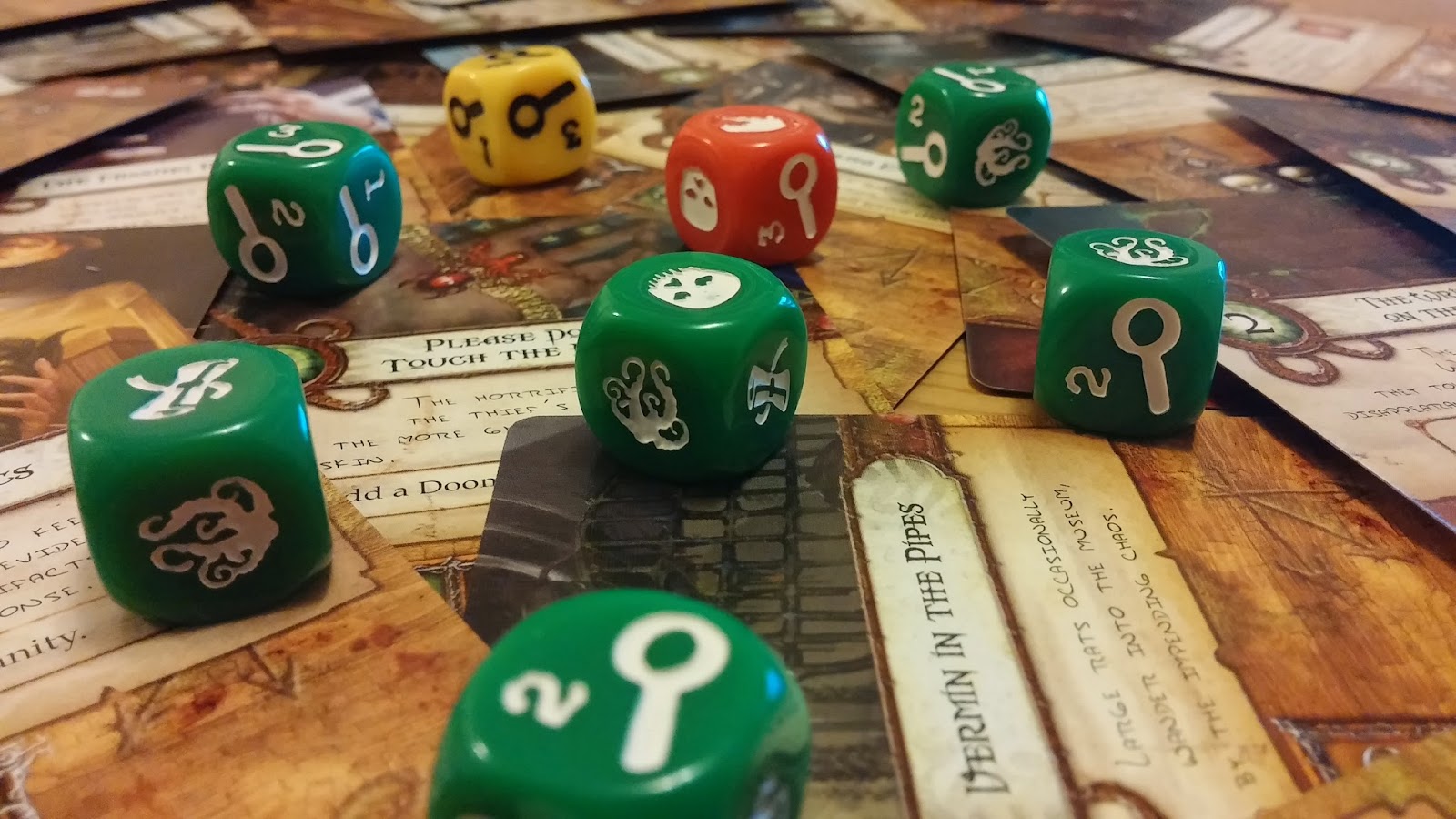
It sounds very dramatic, but the real drama lies in the dice rolling. You move your character token to a card, representing a room in the building, then roll 6-8 dice to try and match the combination of symbols on the card. If you fail to match a row of symbols with some of your dice you must discard one and roll again. Continue to fail and you will run out of dice - and incur a penalty. Succeed however and you will be one step closer to sealing off that ancient, unspeakable evil.


There is more going on in Elder Sign other than dice play - items to collect, cards with (mostly) adverse effects, smaller monsters that can make their way into the rooms, etc. - but the dice are the important part. The strategy and fun come from figuring out the room best suited for the dice you can roll. How can you and your fellow players most effectively pool their resources and character's special abilities to make this turn a success? Because the penalties are harsh and the bad guys are ready to pounce, so you better do all you can to make the odds swing more in your favour.


Dungeon Roll (Tasty Minstrel Games) is a push-your-luck dice game themed around a dungeon crawl. Each player takes it in turns to roll the party dice consisting of six different companions (and a scroll!) and use these companions to explore the dungeon's levels, fighting monsters and collecting treasure. The player to the left of the current hero gets to roll the dungeon dice; these consist of monsters, potions, dragons and chests.


When party dice are used to fight monsters or quaff potions they are sent to the graveyard out of play. Each time the hero ventures further into the dungeon with his/her companions more dungeon dice are rolled, so choosing to push on in the hopes to get more loot and experience points becomes a tough decision with each roll.


There's not a lot more to Dungeon Roll other than a few hero cards with abilities and some treasure tokens (it has a satisfyingly chunky d10 that's used to mark the current dungeon level), there's certainly not as much depth as there is in Elder Sign. However both games share the same thrill in the luck of the dice.

At the centre of both games is that moment of clutching a bunch of dice in both hands, hoping as you shake them to throw some symbols that will really pay off; willing them to land in the perfect combination and turn the tide. Then there's the release as you let them fly, and the tiny pause as you skim the dice faces, hoping you've got the right combination of Fear, Terror and Lore symbols to defeat that last remaining cultist. Or a healthy mix of Goblins, Skeletons and Oozes to make your opposing hero quake in her boots. And finally, the feeling of elation - or disappointment - as you see your fate staring up at you from the table top in those dice faces... and then the next player picks up the dice and it all happens again.

It's an important gaming experience that these two very different games have at their core. One is a casual competitive game, the other is an intense cooperative game. Both succeed in using the roll of the dice to generate excitement and suspense. And when you're deep in the game - and those dice fly - it's hard to beat that thrill.


Sunday, 11 January 2015

Welcome!

Welcome to The Draw Deck. A place where I hope to convey my passion and enthusiasm for board games, and share with you some of my gaming experiences.

I've been playing board games and card games for years, but only recently has it become a slightly obsessive pastime/hobby (my wife might contest my use of the word slightly). My passion has rubbed off onto my friends, and I now have a solid gaming group; each with their own tastes and styles. The only issue is we've all come to this at a slightly inappropriate time. All starting families; all have jobs; all living in different towns. Its hard finding the time to get together and game. I have a one year old daughter, and although I cannot wait to get her in to gaming, she's currently a little young to join in.

I am trying to introduce her to them subtly and gradually

Through social media I have discovered a network of pleasant, passionate gamers that are ready and willing to share their love for their hobby through reviews, photos, how-to-videos etc. So I thought why not join in!?.
I started The Draw Deck in the hope that I might squeeze myself into this community of loyal gamers, and have a conduit to release my thoughts/gripes/opinions/love for these games outside the time I occasionally get to actually play them.

I hope through this blog I can express the reasons why I love gaming, why my friends and family love gaming, and why I hold it in such high regard as a worthy social (and solo) activity. I hope also that it may give me an excuse to buy even more games!